Island Peak may look like a doddle on paper; it's just over 6,000 meters high, and the Nepal Mountaineering Association lumps it in with the so-called "trekking peaks." Plenty of climbers assume that if they've already ticked off Everest Base Camp, they're basically ready for the next step.
But the reality of being clipped into a fixed rope at 5,900 meters, breathing like a broken bellows in the cold dark, and staring up at a wall of ice that seems to go on forever? That's a whole different story.
Island Peak climbing is not a pushover. But it's not extreme mountaineering either. It sits in that tricky middle ground and is tough enough to humble a fit person who hasn't prepared properly, manageable enough for a motivated beginner who has.
This guide goes into the real nitty-gritty of just how hard Island Peak is, what makes it genuinely tough, what parts are totally manageable with the right prep, and whether it's the right mountain for you right now. We guide this peak every season. This is what we actually see on the mountain.
What is Island Peak?
Island Peak or Imja Tse, to use its proper Nepali name, sits in the Everest region of Nepal, tucked in near the villages of Chhukung and Dingboche. At 6,189 metres, it's one of the most popular trekking peaks in the country, and it's easy to see why.
Most itineraries follow the Everest Base Camp route, which means you get a proper, gradual acclimatisation built right into the trip. You're not flying into Kathmandu and attempting a 6,000-metre summit three days later; you're walking up through the Khumbu valley over two weeks, letting your body adjust at every stage. That makes it genuinely accessible compared to most peaks at this altitude. But let's be clear, Island Peak is not just a case of walking up a big hill. Everest Base Camp needs a solid pair of legs. Island Peak needs glacier travel, rope work, crampon technique, and the ability to haul yourself up a seriously steep ice wall at altitude. It's a big step up, and it's worth being honest about that before you book.
How Difficult Is Island Peak Climbing Overall?
Island Peak is officially graded Alpine PD+ – "Peu Difficile" plus, which translates loosely as moderately difficult at the harder end of that bracket. In plain English: not extreme, but not easy either.
The difficulty comes from stacking several different challenges on top of each other at once. You've got the physical demand of a 10 to 14-hour summit day. You've got technical sections that require gear skills you probably haven't used before. You've got altitude working against you at every step. And then there's the mental side, the ice wall in the dark, the exposed ridge, the moment two-thirds of the way up when everything in your body is telling you to stop.
The climbers who make it tend to be fit trekkers who have prepared properly and know their own limits. The ones who struggle usually rush the acclimatisation, underestimate summit day, or turn up without any specific training. Island Peak isn't extreme mountaineering – but it's a heck of a lot tougher than a normal trek, and it has the summit success rates to prove it.
The Technical Difficulty of Island Peak Climbing
This is where Island Peak separates itself from a regular high-altitude trek. There are three distinct technical sections on the route, and each one demands something different from you.
Glacier Travel and Crevasse Crossings
Above base camp, you're on glaciers. Crampons go on, you rope up with your guide, and you pick your way across snow bridges and around crevasse fields. In some seasons, and this varies year to year, there are aluminium ladder crossings over wider gaps.
This section isn't super technical, but it does require balance, confidence, and the ability to stay calm when you're stepping over a ladder strapped above a crevasse with a very long drop underneath it. At altitude, at 5 a.m., in the dark, it gets your attention even if you're experienced.
The Headwall - the Bit That Really Counts
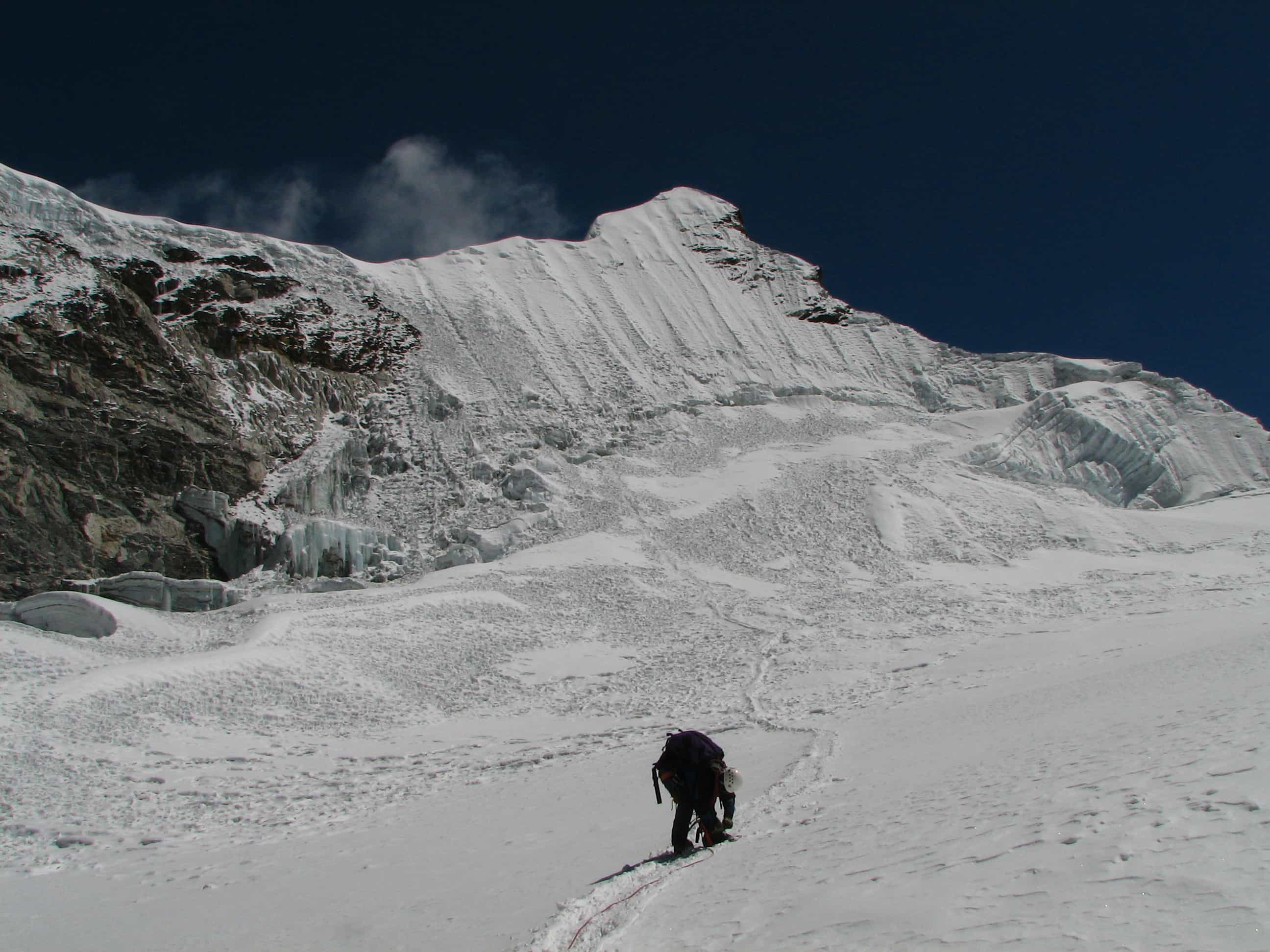
The headwall is the crux of Island Peak, and it's where most people find out what they're made of. It's a wall of steep ice and snow – anywhere from 45 to 65 degrees – climbed using fixed ropes that the climbing Sherpas put in at the start of the season. You clip your jumar (mechanical ascender) onto the rope, kick your crampons in, and climb.
The technique itself is repetitive: jump up, step, jump up, step. It sounds manageable. At 6,000 metres, after five hours of climbing, with arms starting to shake and cold fingers that make every clip feel like it takes twice as long, it's genuinely one of the hardest things most people have ever done.
What makes it manageable: the fixed rope runs the full length of the headwall. You're clipped in throughout. You can go at your own pace. Your guide is with you. And people who thought they couldn't do it very often do because the rope takes some of the load, and the mountain isn't going anywhere while you catch your breath.
The Summit Ridge
After the headwall, you come out onto an exposed, narrow ridge with serious drops on both sides. It's not long, maybe 300 metres to the actual summit, but it's airy and needs steady movement and sharp focus. You stay clipped to the fixed line the entire time.
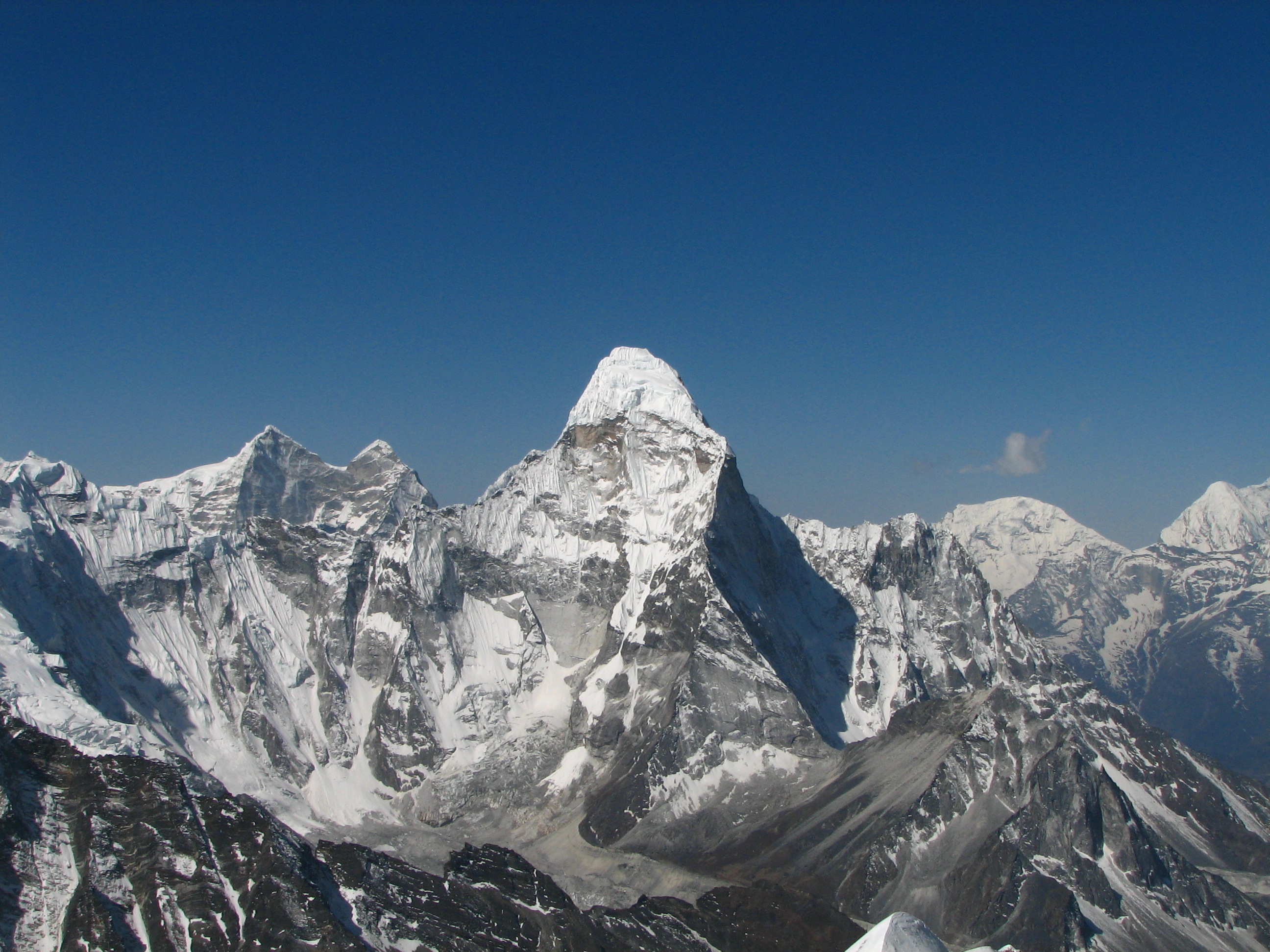
The summit itself is a small patch of snow. The views are extraordinary - Everest, Lhotse, Makalu, Ama Dablam, and Nuptse all visible at once. Four of the world's fourteen 8,000-metre peaks from a single spot, and you've just climbed to 6,189 metres to see them. Not bad for a first-time mountaineer.
How Fit Do You Actually Need to Be for Island Peak?
Island Peak is all about endurance rather than raw strength. Before you even get to the technical stuff, you'll have been trekking for days on end at high altitude with a loaded pack. On summit day, you're looking at 10 to 14 hours of sustained effort with no real rest until you're back at camp.
Strong legs, a solid cardiovascular base, and genuine stamina matter far more than anything you'll ever develop in a gym. Long hikes, stair climbing, hill training with a weighted pack, all of this is going to serve you far better than sessions on a treadmill or a chest press machine.
A climber who can comfortably hike 6 to 8 hours back to back for a couple of days with a 10 to 12 kg pack, uphill, is usually in the right ballpark physically, provided they've also given themselves enough time to acclimatise properly. The altitude is what humbles even very fit people who've never been above 4,000 metres.
Training That Actually Helps
The most effective preparation is dead simple: walk uphill, a lot, with a heavy pack. Three or four months of consistent training beats six weeks of intense gym work every time.
Pull-ups are worth adding in specifically for the headwall – you're essentially hauling your bodyweight up a fixed rope. If you can get to 8 to 10 pull-ups before you leave home, summit day is noticeably less brutal on your arms. A session or two at a climbing gym, getting comfortable with a harness and ascender, is also worth every bit of effort if you can manage it.
The Altitude Difficulty – This Is the Big One
If you want to know what makes Island Peak genuinely hard, it's this: the altitude. At 6,189 metres, your body is running on roughly half the oxygen it gets at sea level. And that affects absolutely everything.
Movements that feel effortless at home feel like proper work up here. Clipping into a rope takes longer. Putting on a crampon requires concentration. Resting becomes something you do seriously rather than briefly. Even strong, fit climbers are sometimes shocked at how much harder altitude makes every single thing they do.
Headaches, lost appetite, terrible sleep, and a general feeling of being utterly wiped out are all normal signs of altitude stress. They don't necessarily mean you're in trouble – but they do mean your body is working overtime just to keep you going.
Why Acclimatisation Is Everything
The good news is that the standard Island Peak itinerary is built around solving this problem. Following the Everest Base Camp route means you're spending two weeks walking up through the Khumbu, spending nights at Namche Bazaar, Dingboche, and eventually base camp, letting your body produce more red blood cells at each stage before you attempt the summit.
Those extra rest days, particularly the second night at Namche and the acclimatisation day at Dingboche, aren't filler. They're the reason the itinerary works. Climbers who skip them or choose a shorter schedule to save money are the ones we most often see turning around before the headwall.
On summit day, the altitude really bites. Something as simple as adjusting your crampon strap or clipping your jumar can feel like a major task. Moving slowly and deliberately – not fighting the mountain, not trying to rush through it – is genuinely more important than strength or fitness at this point.
The Mental Challenge of Island Peak – Harder Than It Looks
Island Peak will test your head just as much as your body. Summit day kicks off somewhere between midnight and 2 a.m. You're climbing in darkness, silence, and serious cold before you've had a chance to fully wake up, and you've already been on the trail for several hours before you even reach crampon point.
Fear has a habit of showing up on the steep bits. The headwall, the exposed ridge, the fixed ropes in the dark, if this is your first time on a mountain like this, it can be properly intimidating. Most climbers have a moment, usually about two-thirds of the way up the headwall, where a small voice pipes up and says, "Enough."
That voice is normal. It's not a signal to stop, it's a signal to slow down, breathe, and keep going. The climbers who recognise that moment for what it is and push through it are the ones who make the summit. The ones who let it take over are the ones who call it a day, fifty metres below the ridge.
Running on Empty
Fatigue amplifies everything. When you're physically spent and sleep-deprived at 6,000 metres, fear feels bigger, doubt feels louder, and even straightforward tasks feel overwhelming. This is why the mental game isn't separate from the physical prep – they're the same thing. A body that's been trained properly is a mind that stays steadier under pressure.
The most consistent advice from climbers who've done it: focus on the next step, not the summit. The summit is too far away to be useful as a mental anchor. The next crampon placement is right in front of you. One step at a time really does work.
What Actually Happens on Island Peak Summit Day?
People are often surprised by how long and involved summit day is. Here's the honest breakdown from start to finish.
The Approach: Base Camp to Crampon Point
The day starts in the dark – usually 1 to 2 a.m. from base camp (5,100 m) or midnight from high camp if you're using one. The first few hours are a steep scramble over loose rock and scree in headlamp light, gaining around 500 metres of elevation before you even get near the glacier.
There's nothing technical about this section, but it's surprisingly tiring. By the time you reach crampon point, you've been going for three to four hours, and the real climbing hasn't started yet. A lot of people underestimate how much this takes out of them.
Glacier Crossing to the Headwall Base
Crampons on, harness buckled, ice axe out. You rope up with your guide and pick your way across the glacier – crevasse crossings, ladder bridges, the lot. The glacier is relatively flat, but the terrain changes year to year, and the psychological reality of the crevasses at altitude in the cold is something you can't really prepare for by reading about it.
The Headwall and Summit Ridge
You'll spend one to two hours on the headwall, depending on your pace and the queue. Then the exposed ridge walk to the summit – 15 to 20 minutes on the rope with the most spectacular views you've ever seen.
The Descent
The descent is not a rest. Abseiling down the headwall, crossing the glacier in reverse, and the long slog back down the rocky approach all need full concentration. A significant number of accidents in the mountains happen on the way down when people are tired and their guard drops. This is not the moment to switch off.
Total round trip from base camp: 12 to 14 hours. From high camp: 10 to 12 hours. That's the day you need to be ready for.
Island Peak vs Mera Peak – Which Is Harder?
This is one of the most common questions we get. The short answer: Island Peak is harder, even though it's lower.
Mera Peak stands at 6,476 metres, nearly 300 metres higher than Island Peak. But the standard Mera route is essentially a long glacier walk with no significant technical sections. It's physically demanding at that altitude, but there's no headwall, no fixed rope jumar work, and nothing that requires technical gear skills.
Island Peak at 6,189 metres has the headwall, the crevasse crossings, the fixed rope work, and the exposed summit ridge. It's a more technically involved climb by a significant margin. Most experienced guides – including ours – would say the Island Peak summit feels more earned, despite being lower.
If you've done Mera Peak and want to step up the challenge, Island Peak is the natural next move. If you haven't done either and you're deciding where to start, Mera is the more forgiving introduction, and Island Peak is the bigger test.
Common Mistakes That Make Island Peak Way Harder
Island Peak is not a mountain you want to rush. A lot of the difficulty people experience isn't inherent to the peak; it's the result of decisions made weeks or months before they even land in Kathmandu.
Rushing the Acclimatisation
This is the number one reason people turn back. Skipping rest days, choosing the shortest possible itinerary, pushing higher too quickly at altitude, all of that is just asking for trouble. Without proper acclimatisation, your body never gets the chance to adapt, and summit day becomes an uphill battle from the first step.
The minimum itinerary we recommend for Island Peak is 16 days from Lukla, combining the EBC acclimatisation route with the climb. Anything shorter significantly increases your AMS risk and your chance of arriving at the headwall already running on fumes.
Skimping on the Physical Prep
A lot of people think general fitness is enough. It isn't. Island Peak needs long days of walking, uphill climbing, and sustained effort at altitude. Someone who can run a fast 10k but hasn't done a single long day hike with a weighted pack before arriving will struggle badly. Cardiovascular endurance for duration, not speed, is what this mountain demands.
Underestimating Summit Day
Ten to fourteen hours. In the cold. Starting in the dark. With technical gear skills you've only just learned. That's the day. Climbers who don't mentally prepare for the full scope of what summit day involves often run out of steam – not because they lack the ability, but because they had no idea what they were actually signing up for.
Skimping on Guide Quality
A good guide isn't just there for navigation. They're watching your pace, reading your body language, managing the rope on the headwall, making the call on whether to push on or turn back, and keeping you safe in conditions that change fast at altitude. Cutting corners on guide experience or choosing the cheapest operator available is a false economy when you're at 6,000 metres.
Do You Need Prior Climbing Experience for Island Peak?
You don't need to be an experienced mountaineer to climb Island Peak – loads of successful climbers have come from a trekking background with zero technical climbing history. The skills you need are taught at base camp the day before the summit attempt.
Your guides will walk you through crampon technique, how to wear and use a harness, clipping into fixed ropes, using a jumar ascender to climb, and abseiling on the descent. It's genuinely solid training, and most people pick it up quickly – but there's a difference between learning something once in daylight at 5,100 metres and deploying it at 6,000 metres with cold hands in the dark. The more familiar you are with the gear before you arrive, the better summit day will go.
What matters far more than prior experience is your attitude on the mountain. Climbers who listen, stay calm, follow their guide's instructions, and move steadily tend to do way better than experienced but impatient climbers who want to push ahead of the pace. Panic and ego cause more problems up here than inexperience does.
Experience That Does Help
Having done a high-altitude trek before – Everest Base Camp, Annapurna Circuit, or something similar – is a genuine advantage. It means you already know how your body responds to altitude, you've developed the mental habits that sustained mountain days require, and the logistics of trekking at elevation don't feel completely foreign.
That's not a requirement. But if you haven't done anything at high altitude before, Island Peak is a significant jump. A lower altitude trek first isn't a bad idea.
How a Good Guide Changes the Difficulty Equation
This one gets undersold a lot. A strong, experienced climbing guide doesn't just reduce the risk of Island Peak – they genuinely make the climb more manageable. They're setting the pace for you, which at altitude is one of the most important things anyone can do. Too fast and you're blowing up before the headwall. The right pace and you're saving energy for the sections that actually need it.
They fix the ropes before you arrive, manage the technical sections, read the weather, know when the summit window is closing, and when it's safe to push on. They've done this dozens or hundreds of times. All of that experience is in your corner.
On the headwall itself, having a guide who has made that same climb season after season is an enormous confidence anchor. They know the route, they know the conditions, and they know what your body language is telling them about whether you're genuinely struggling or just having a hard five minutes.
Who Should Climb Island Peak – and Who Probably Isn't Ready Yet
Island Peak is a brilliant first mountaineering experience, but it genuinely isn't right for everyone. Being honest with yourself about where you're at will make your trip safer, more enjoyable, and a lot less stressful.
You'll Have a Strong Shot at the Summit If You...
Have done a multi-day high-altitude trek before (EBC, Annapurna Base Camp, or similar)
- Can hike 6 to 8 hours back-to-back with a loaded pack without completely falling apart
- Have been training consistently for 3+ months before the trip
- Have a high tolerance for discomfort and can keep a level head when things get hard
- Don't have a serious fear of heights or exposed terrain
- Are you willing to put real time into gear familiarisation before you arrive
You Might Want to Work Up to It If You...
- Have never trekked at altitude – don't make Island Peak your first experience above 3,500 metres
- Struggle significantly on steep terrain, heights, or exposure
- Haven't been able to train regularly in the months leading up to the trip
- Are planning to do it on a very short itinerary to keep costs down – the summit success rate drops sharply
- Have a cardiovascular condition that hasn't been specifically cleared for high-altitude exercise
Age is not a barrier. We've guided climbers from their twenties to their late sixties to the Island Peak summit. What makes the difference is fitness, acclimatisation, and attitude – not what year you were born.
Does the Season Affect How Hard Island Peak Is?
Yes – quite a bit, actually. The season you climb in doesn't just change the comfort level; it changes the difficulty of the climb itself.
Spring (April and May) – The Sweet Spot
Spring is the prime season for Island Peak, and the most popular for good reason. Temperatures are more manageable, the weather windows are reliable, and the snow conditions on the headwall tend to be firmed, which makes crampon technique more secure and the fixed rope work more straightforward. April is the most consistent month. May is slightly warmer, and the summit views are typically clear.
Autumn (October and November) – Equally Good, Quieter
Autumn is the other top season, and it has one real advantage over spring: the mountain is quieter. Fewer people means shorter queues on the headwall and less rockfall risk from parties above you. October in particular has post-monsoon skies that are often crystal clear. It's colder than spring, especially at night, but the conditions are stable, and the mountain is in great shape.
Winter and Monsoon – Steer Clear
Winter climbing (December to February) is possible, but the pre-dawn temperatures on the headwall become genuinely dangerous for your extremities. Frostbite risk goes up significantly, and the cold makes gear operation much harder. Monsoon season (June to August) brings heavy snowfall, poor visibility, and serious avalanche risk. Very few operators run Island Peak trips in either season, and for good reason.
So, is Island Peak Worth It?
Island Peak is a tough ask. Anyone who tells you otherwise is selling you something.
The headwall at 6,000 metres, the 12-plus hour summit day, the gear skills you've never used before, the altitude working against you the whole way up – all of that is real. It will be the hardest thing many people who attempt it have ever done.
And the summit is genuinely worth every bit of it. Four of the world's fourteen 8,000-metre peaks are visible from one spot. A mountain you climbed with your own hands and legs and lungs, via a headwall that nearly stopped you. That's not something you forget.
What puts the summit within reach isn't a special talent for mountaineering. It's showing up properly prepared – trained for duration, acclimatised properly, with gear you know how to use and a guide team you trust. Do that, and Island Peak is one of the most rewarding first climbs on the planet.