2026-04-13
11 min read
So you have decided to go to Everest Base Camp trek. It is one of the most famous trips in the world and a really fulfilling experience. Here is what many people who are going for the first time do not realize: the trek does not require you to be a professional climber, but it does require you to be in good physical shape.
Everest Base Camp is 5,364 meters above sea level. The whole trip from Lukla is 130 kilometers and takes around 12 to 14 days. You will be hiking for 4 to 7 hours a day on rocky and uneven paths. If you do not have a training plan, the high altitude and physical demands can make your trip very difficult.
This guide gives you everything you need to prepare. It has a training plan for Everest Base Camp, broken down week by week. This will help you arrive in the Khumbu region feeling confident, strong, and ready for the trek to Everest Base Camp.
This plan suits individuals with moderate fitness who lack altitude trekking experience. Active hikers or runners can increase intensity. If sedentary, start training 5–6 months before your trek.
Start training 3 to 6 months before the trek-more time is better. Fitness and especially altitude adaptation cannot be rushed.
Before building your training plan, you need to understand what the trek actually puts your body through.
Elevation gain and loss: You will gain and lose significant elevation every single day. The trail is not a straight climb. You go up, come down, cross river valleys, and climb again. Your knees and ankles take a beating on the descents.
Duration: You will hike for 5 to 7 hours most days, sometimes longer. This means your cardiovascular system and leg muscles must be able to sustain moderate effort for long periods.
Altitude: Above 3,500 meters, your body receives less oxygen with every breath. Your heart rate increases. Breathing becomes heavier. Physical effort that felt easy at sea level becomes noticeably harder. Training at sea level will not simulate altitude, but it will build the aerobic base your body needs to cope.
Pack weight: You will carry a daypack weighing anywhere from 5 to 10 kilograms. Your training must include loaded hikes to prepare your shoulders, hips, and core.
Your training plan should be built around four core areas.
1. Cardiovascular endurance - This is the foundation. You need a strong heart and efficient lungs to manage sustained effort at altitude.
2. Leg strength - Uphill climbing builds your quads and glutes. Descending hammers your knees. You need strength in both directions.
3. Core stability - A strong core keeps you balanced on uneven terrain and reduces back strain from carrying your pack.
4. Long-distance hiking practice - Nothing prepares you for a long hiking day better than long hiking days. Weekend hikes are non-negotiable.
In the first two months, your goal is to build a consistent aerobic base and introduce your body to regular movement if it is not already accustomed to it.
Cardio: 3 to 4 times per week. Choose activities like brisk walking, jogging, cycling, or swimming. Aim for 30 to 45 minutes per session. Keep the effort comfortable — you should be able to hold a conversation. This zone builds your aerobic engine.
Strength training: 2 times per week. Focus on the lower body and core. Key exercises include squats, lunges, step-ups onto a box or bench, calf raises, glute bridges, planks, and dead bugs. Do 3 sets of 10 to 15 repetitions each.
Weekend hike: Once per week. Start with 2 to 3 hours on rolling terrain. Wear your trekking boots and carry a light daypack. This is critical — your boots need to be broken in long before you land in Kathmandu.
Rest and recovery: Take at least one full rest day per week. Sleep and recovery are where your fitness actually improves.
By month three, your body should be adapting to regular movement. Now you begin increasing the duration and adding pack weight to your hikes.
Cardio: Increase sessions to 45 to 60 minutes. Add one session of interval training per week — alternate between 1 minute of hard effort and 2 minutes of easy effort for 20 to 30 minutes. This builds your cardiovascular ceiling.
Stair climbing: Introduce stair climbing or step machine sessions twice a week. This directly mimics the uphill demands of the trek. Aim for 20 to 30 minutes per session.
Strength training: Continue twice per week. Increase difficulty by adding weight — use dumbbells for lunges and step-ups. Add single-leg deadlifts and wall sits to build joint stability.
Weekend hike: Increase to 4 to 5 hours. Add 5 kilograms to your daypack. Focus on hilly terrain whenever possible.
Month four is where your training starts to feel genuinely demanding. This is by design.
Cardio: Maintain 4 sessions per week. Increase duration to 60 to 75 minutes for two of those sessions. Keep two sessions shorter but more intense. Your body should now be comfortably in its aerobic zone for extended periods.
Stair climbing: Increase to 40 minutes per session. Where possible, climb actual stairs or hills rather than using a machine. The variable terrain recruits more stabilizing muscles.
Strength training: Add single-leg exercises to simulate the off-balance terrain of rocky trails. Bulgarian split squats, single-leg press, and lateral band walks are excellent additions. Train your tibialis anterior (shin muscles) to prevent shin splints.
Weekend hike: Push your weekend hike to 5 to 7 hours. Carry 7 to 8 kilograms. If possible, plan back-to-back hiking days to simulate consecutive trekking days on the trail. Hike Saturday and Sunday, even if the Sunday hike is shorter.
Month five is your hardest month. You are building maximum fitness before your taper period.
Cardio: 5 sessions per week. Two sessions should be 75 to 90 minutes at a comfortable aerobic pace. One session should be interval-based. The remaining sessions are moderate 45 to 60-minute efforts.
Stair climbing: Aim for 45 to 60 minutes. If you have access to a steep hill, replace the machine entirely. Carry your loaded pack during these sessions.
Strength training: Shift to functional, unilateral movements. Single-leg squats, step-ups with a heavy pack, and lateral lunges. Focus on injury prevention at this stage — do not push to failure. Add hip and glute activation exercises to protect your knees on long descents.
Weekend hikes: This is the most important part of month five. Do a full day hike of 7 to 9 hours with an 8 to 10 kilogram pack. If possible, tackle consecutive hiking days for two or three weekends in a row. Some trekkers choose to do a shorter Himalayan trek, such as Langtang or Annapurna Sanctuary, during this month as the ultimate preparation.
The last 2 to 3 weeks before your trek, you taper. This means reducing your training volume while maintaining intensity. Your muscles need to be fresh, not fatigued, when you step off the plane.
Week 3 before departure: Reduce all training by 20 percent. Maintain the same frequency but cut session durations.
Week 2 before departure: Reduce by 40 percent. Focus on easy walks, light stretching, and yoga. No heavy strength sessions.
Final week: Light walks only. Focus on sleep, nutrition, and final gear checks. Trust your training.
No amount of sea-level training will fully prepare your lungs for the thin air above 4,000 meters. However, several strategies can help.
Acclimatize in Kathmandu: Arrive in Kathmandu one to two days early. The city sits at 1,400 meters. Your body begins adjusting immediately.
Follow the golden rule: Never ascend more than 300 to 500 meters in sleeping altitude per day above 3,000 meters. The EBC itinerary is designed with this in mind, but resist the urge to rush.
Stay hydrated: Drink 3 to 4 liters of water per day on the trail. Dehydration worsens altitude sickness symptoms significantly.
Consider acetazolamide (Diamox): This medication helps your body acclimatize faster by stimulating breathing. Speak to your doctor at least 4 weeks before departure to discuss whether it is right for you.
Sleep low, hike high: On acclimatization days, hike to a higher elevation and return to a lower camp to sleep. This accelerates your body's adaptation.
Know the symptoms of AMS: Acute Mountain Sickness includes headache, nausea, dizziness, fatigue, and loss of appetite. If symptoms worsen rather than improve after 24 hours of rest, descend immediately. No view is worth your life.
Training hard without eating properly is like fueling a car with water. Your nutrition during training matters as much as the training itself.
Protein: Aim for 1.6 to 2 grams of protein per kilogram of body weight daily. This supports muscle repair and growth. Sources include eggs, chicken, fish, legumes, Greek yogurt, and protein shakes.
Carbohydrates: Do not fear carbohydrates during heavy training. They are your primary fuel source for aerobic exercise. Eat oats, rice, sweet potatoes, whole-grain bread, and fruit.
Iron: Many trekkers, especially women, become iron-deficient under heavy training loads. Iron supports red blood cell production, which is crucial for oxygen delivery at altitude. Eat iron-rich foods such as red meat, spinach, lentils, and fortified cereals. Pair them with vitamin C to improve absorption.
Hydration: Train yourself to drink consistently throughout the day, not just when you feel thirsty. This habit transfers directly to the trail.
Your gear is part of your training. Never show up to a trek with brand-new boots. Prepare a gear list for everest base camp trek:
Break in your boots: Wear your trekking boots on every hike from month one. Your feet need time to adapt to the boot shape and vice versa. Blisters on day one of an EBC trek are a miserable way to start.
Train with your pack: Wear your actual daypack during training hikes. Load it to the weight you expect to carry on the trek. This trains your shoulders, hips, and core in the exact positions they will be under stress.
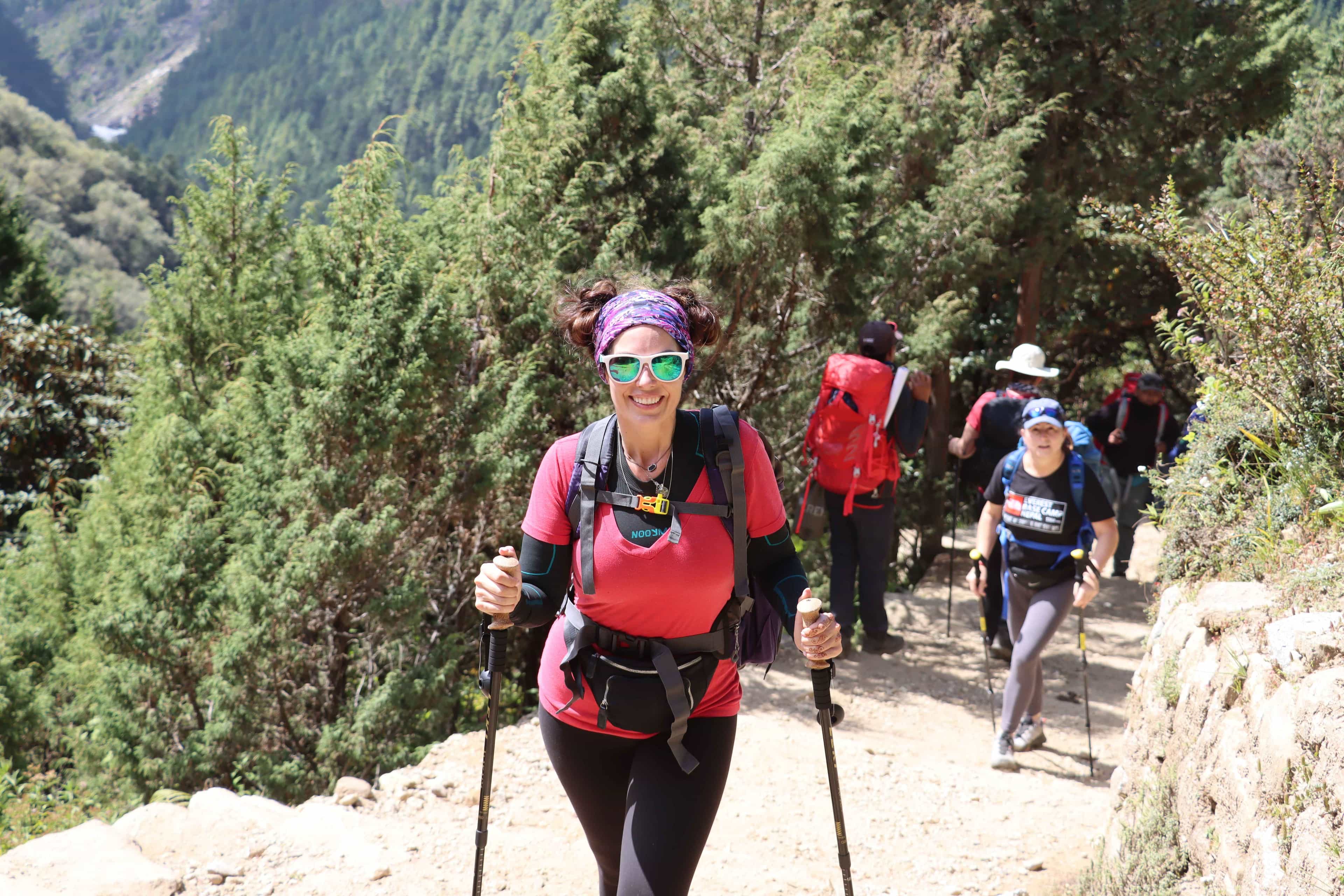
Use trekking poles: If you plan to use poles on the trek — and you should — practice with them during your training hikes. Poles significantly reduce knee strain on descents and help with balance.
Wear your trekking socks: The socks you wear affect comfort and blister risk. Wool or synthetic moisture-wicking socks are best. Train in them consistently.
Learn more about: Everest Base Camp Trek Water Cost
Starting too late: Six months is the recommended minimum. Three months can work for already-fit individuals, but it adds risk. Give yourself enough time.
Neglecting descents: Most people train going uphill and ignore downhill training. Descending puts enormous stress on the knees. Practice walking downhill with a loaded pack. Strengthen your quads with eccentric exercises such as slow descent squats.
Skipping rest days: Rest is not laziness. It is when your body gets stronger. Overtraining leads to injury, and an injury two months before your trek is devastating.
Ignoring your feet: Foot care is serious business on a long trek. Practice clipping your toenails short to avoid bruising under the nail on descents. Manage any hot spots during training hikes with moleskin before they become blisters.
Not practicing with altitude: If you live at sea level, consider a training hike or weekend at a higher elevation once during your training. Even a night at 2,000 to 3,000 meters gives your body a preview of what is coming.
Monday: 60-minute jog or cycle at aerobic pace
Tuesday: Strength training — lower body and core (45 minutes)
Wednesday: 45-minute interval session on the stair machine or hill
Thursday: Strength training — functional, unilateral focus (45 minutes)
Friday: Rest or gentle yoga and stretching
Saturday: Long hike — 6 hours, 7 to 8 kg pack, hilly terrain
Sunday: Moderate hike — 2 to 3 hours recovery pace, same pack
Everest Base Camp is tough. It is meant to be that way. Every year, thousands of people finish it, and these people are not just young folks. There are people in their 60s and 70s who do it, people who never went trekking before, and people who started training from the beginning. What makes some people finish Everest Base Camp and others give up is not usually because they are naturally good at it. It is because they prepared for the Everest Base Camp.
You should follow this training plan for Everest Base Camp. You should take it seriously. You should go for hikes on the weekends even when you really want to stay home. You should wear your boots a lot so they are comfortable. You should drink a lot of water. You should get a lot of sleep. You should trust the process of training for Everest Base Camp.
When you are finally standing at Everest Base Camp, and you look up at Khumbutse and the Khumbu Glacier, you will think that all the early mornings and tired nights were worth it, for Everest Base Camp.
+
+
+
+
+
+
+
© 2026 5k Treks Pvt. Ltd. All rights reserved.